Share Transforming Biosolids into Biochar on FacebookShare Transforming Biosolids into Biochar on X (formerly Twitter)Share Transforming Biosolids into Biochar on LinkedinEmail Transforming Biosolids into Biochar link
Innovating Wastewater Treatment: Transforming Biosolids into Biochar
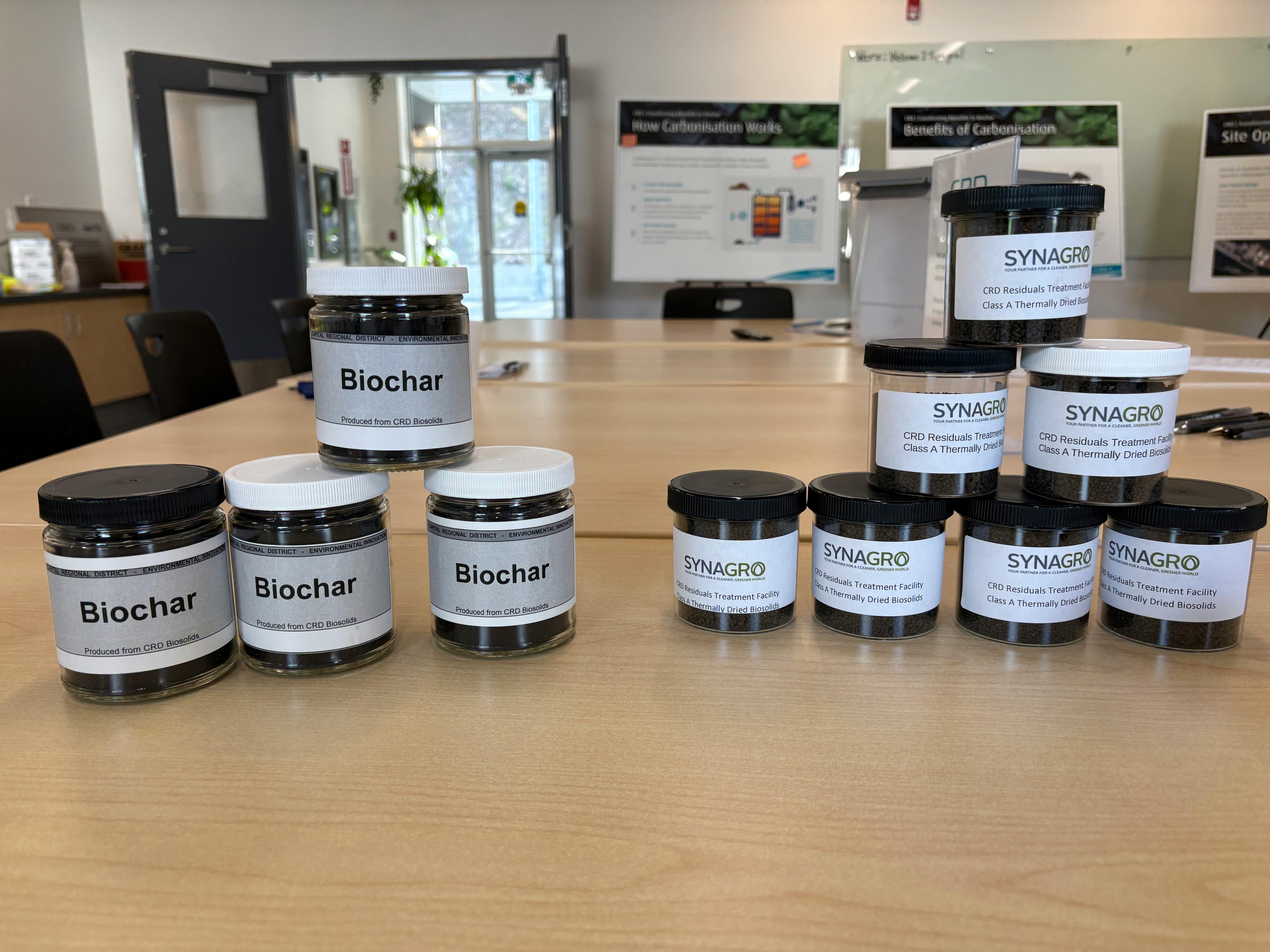
The CRD is taking an important next step toward introducing carbonisation technologyto transform Class A biosolids, the solids left over from wastewater treatment, into biochar, a carbon-rich material that helps reduce greenhouse gas emissions, destroy contaminants of concerns, and store carbon. This will be the first project of its kind in Canada and builds on the CRD’s strategic investments in wastewater treatment to maximize resource recovery.
Since wastewater treatment was introduced in 2020, the CRD has been pursuing sustainable, cost-effective options to use biosolids for community benefit. In 2024, the CRD Board identified thermal technologies [carbonisation] as the long-term approach to converting biosolids to biochar - a stable, carbon-rich product offering a variety of potential benefits across construction, industrial, agriculture, and forestry sectors.
Introducing the added carbonisation step to wastewater treatment is cost-competitive with the CRD’s current biosolids management practices, while significantly reducing volumes, destroying contaminants of concern, and locking in carbon.The process will move forward in stages, with clear decision points for the CRD Board and opportunities for input from First Nations and the public. At each stage, engagement and feedback will help shape the next steps.
Subscribe for updates to keep informed on the project.
Innovating Wastewater Treatment: Transforming Biosolids into Biochar
The CRD is taking an important next step toward introducing carbonisation technologyto transform Class A biosolids, the solids left over from wastewater treatment, into biochar, a carbon-rich material that helps reduce greenhouse gas emissions, destroy contaminants of concerns, and store carbon. This will be the first project of its kind in Canada and builds on the CRD’s strategic investments in wastewater treatment to maximize resource recovery.
Since wastewater treatment was introduced in 2020, the CRD has been pursuing sustainable, cost-effective options to use biosolids for community benefit. In 2024, the CRD Board identified thermal technologies [carbonisation] as the long-term approach to converting biosolids to biochar - a stable, carbon-rich product offering a variety of potential benefits across construction, industrial, agriculture, and forestry sectors.
Introducing the added carbonisation step to wastewater treatment is cost-competitive with the CRD’s current biosolids management practices, while significantly reducing volumes, destroying contaminants of concern, and locking in carbon.The process will move forward in stages, with clear decision points for the CRD Board and opportunities for input from First Nations and the public. At each stage, engagement and feedback will help shape the next steps.
Subscribe for updates to keep informed on the project.
Share CRD receives funding for the Biochar Project on FacebookShare CRD receives funding for the Biochar Project on X (formerly Twitter)Share CRD receives funding for the Biochar Project on LinkedinEmail CRD receives funding for the Biochar Project link
As part of the Government of Canada's July 30 announcement of more than $152 million for 54 infrastructure projects across British Columbia, the Capital Regional District received $7 million through the Build Canada Strong Fund to introduce carbonisation technology at the Residuals Treatment Facility, located at Hartland Landfill, transforming Class A biosolids from wastewater treatment into biochar.
As part of the Government of Canada's July 30 announcement of more than $152 million for 54 infrastructure projects across British Columbia, the Capital Regional District received $7 million through the Build Canada Strong Fund to introduce carbonisation technology at the Residuals Treatment Facility, located at Hartland Landfill, transforming Class A biosolids from wastewater treatment into biochar.
Share Core Area Wastewater AAP on FacebookShare Core Area Wastewater AAP on X (formerly Twitter)Share Core Area Wastewater AAP on LinkedinEmail Core Area Wastewater AAP link
On June 18, the CRD initiated an Alternative Approval Process (AAP) to seek elector approval for the purpose of capital renewal and wastewater system upgrade projects planned for the Core Area and Western Communities service area.
One item in the AAP includes up to $2 million to support design, site planning, and air quality modelling for the introduction of carbonization technology to the Residuals Treatment Facility at the Hartland Landfill.
You can find more information about the AAP, including the elector response form, at www.crd.ca/Wastewater-AAP.
On June 18, the CRD initiated an Alternative Approval Process (AAP) to seek elector approval for the purpose of capital renewal and wastewater system upgrade projects planned for the Core Area and Western Communities service area.
One item in the AAP includes up to $2 million to support design, site planning, and air quality modelling for the introduction of carbonization technology to the Residuals Treatment Facility at the Hartland Landfill.
You can find more information about the AAP, including the elector response form, at www.crd.ca/Wastewater-AAP.
Share The public feedback period is now complete. on FacebookShare The public feedback period is now complete. on X (formerly Twitter)Share The public feedback period is now complete. on LinkedinEmail The public feedback period is now complete. link
Thank you for your interest in the CRD’s plans for introducing biochar technology to the Residuals Treatment Facility at the Hartland Landfill. Input collected through the recent public engagement process will inform further planning around introducing carbonisation technology to convert biosolids to biochar.
The What We Heard report summarizes what we learned through the online survey and open house.
The planning and implementation of carbonisation technology is a multi-step, multiyear process with several opportunities for public feedback. We have completed our engagement on the overall process and planning . There will be future opportunities to provide input on permitting for air emissions, borrowing, and end uses of biochar.
Thank you for your interest in the CRD’s plans for introducing biochar technology to the Residuals Treatment Facility at the Hartland Landfill. Input collected through the recent public engagement process will inform further planning around introducing carbonisation technology to convert biosolids to biochar.
The What We Heard report summarizes what we learned through the online survey and open house.
The planning and implementation of carbonisation technology is a multi-step, multiyear process with several opportunities for public feedback. We have completed our engagement on the overall process and planning . There will be future opportunities to provide input on permitting for air emissions, borrowing, and end uses of biochar.
Share Public invited to learn more about innovative system to convert biosolids to biochar on FacebookShare Public invited to learn more about innovative system to convert biosolids to biochar on X (formerly Twitter)Share Public invited to learn more about innovative system to convert biosolids to biochar on LinkedinEmail Public invited to learn more about innovative system to convert biosolids to biochar link
The public is invited to provide feedback as the Capital Regional District (CRD) prepares to take an important step in the treatment of wastewater and processing of biosolids, introducing high-heat technology to help reduce greenhouse gases, capture carbon, and improve soil nutrients.
The public is invited to provide feedback as the Capital Regional District (CRD) prepares to take an important step in the treatment of wastewater and processing of biosolids, introducing high-heat technology to help reduce greenhouse gases, capture carbon, and improve soil nutrients.